
Orthodox Action
A kind of manifesto By Saint Maria of Paris

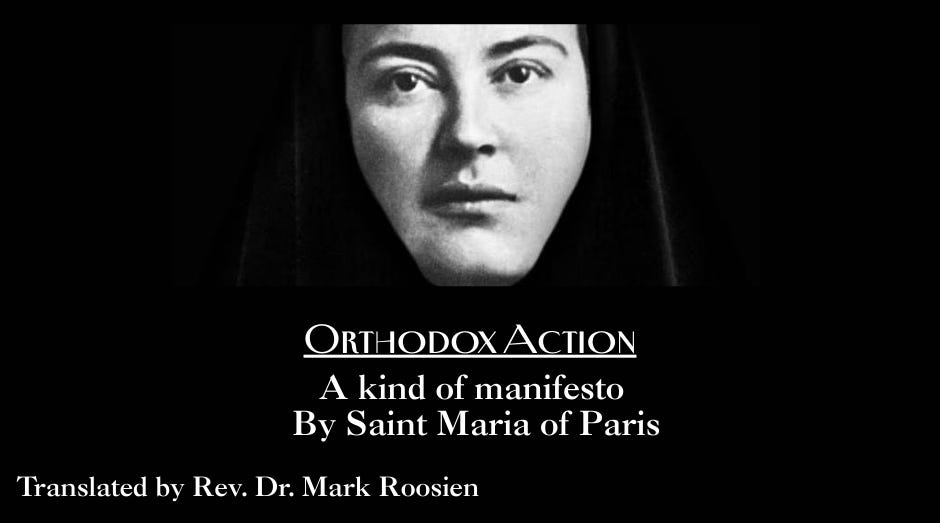
This article was written by Mother Maria as a kind of manifesto for the group “Orthodox Action,” a “missionary center,” soup kitchen, and hostel located in a run-down property on 77 rue de Lourmel in Paris, where poor Russian émigrés were numerous. Founded in 1935 by Mother Maria, Nikolai Berdyaev, Fr Sergii Bulgakov, and Georgii Fedotov, the group set as its primary task to provide material, pedagogical, and liturgical support to the neediest of the Russian émigré community.(1)
It is unbearable to hear or read any theoretical discussions about the organization of life. From university departments, in heated debates in various meetings, people are trying to squeeze life into schemas and forms, to hammer its irreconcilable multiformity into molds determined in advance. Politicians, predicting what is going to happen decades from now, get lost and confused amidst the little things of the present day; economists, knowing how to solve all conflicts and crises, cannot make ends meet in their measly budgets; altruists, wishing to help out the whole universe, do not notice the living human being beside them.
In reality, only in the youth is it possible not to see anything of this absurd satire, this glaring contradiction. With age grows cautiousness, it gives birth to irony, and there arises an absolute inability to accept all these strict diagnoses and doctors’ prescriptions encapsulated in the words, “Physician, heal thyself.”
But if this is true in the arena of politics and economics–of all kinds of sociality–then it is especially unbearable to hear conversations now about Christianity–about Christ and about the Church.
In halls, salons, and cafes–with astonishing carelessness–theories, opinions, sharp paradoxes, and strands of thought are ever increasing. Today we profess the principles of extreme asceticism, but tomorrow, as if there were something already attained and outlived from this purely notional experience, we search for something with new impressions in theories about massive social experiments. And in every place, in every tune, a single word rings out: crisis. In fact, the primary essence of the crisis is itself demonstrated in this fragmentary, non-holistic answer to the questions of modernity: it is a crisis of the wholeness of life, of its very core.
We are going to try, starting from the largest and most absolute, to build a bridge to our everyday bustle, to every fact of our small, concrete life. The fact that it is still in emigration, our life, doesn’t mean that these grand perspectives ought not be discussed by us, the ungrounded, the incidental–those who are shrinking away.
We stand before the truth of the Lord and aspire to understand its requirements.
On the contrary, to each of us is given a destiny, which is not lesser, and also no less tragic, because of the fact that it was given to us in Paris, and not in Moscow. All of us have been given birth, love, friendship, a thirst for creativity, the feeling of compassion, of justice, of yearning for the eternal—and each of us will be given the hour of death. We stand before the truth of the Lord and aspire to understand its requirements.
But the Truth of the Lord tells us that heaven cannot contain It—and yet the manger of Bethlehem contained it; that It creates and sustains the world—and yet it collapsed beneath the weight of the cross on the road to Golgotha; that It is greater than the universe—and yet at the same time does not disdain a cup of water given to it by a compassionate hand. The Truth of the Lord abolishes the distinction between the uncontainable and the insignificant.
We are trying to order our small, insignificant life like the great Creator ordered the solar system, drew a line across the face of the Universe.
First of all, we must sharply disavow a prejudice shared by even the most diverse people. Among hyper-orthodox theologians you may hear that there’s no point in ordering life. We have been given but one task—to save our soul—and social justice (2), artistic creativity, scientific work and so forth—none of that matters to us; it is just a “job,” an obedience that has no decisive impact on our inner life. Clearly, these “Orthodox” opinions are echoes of Rozanov in his famous comments about Christianity. In Christ, the world is sour; choose between His sorrowful Face or the enjoyment of life. (3) Rozanov—and this is astounding—was, for a whole group of people, just about the only exegete and commentator on Christianity; he was a kind of Father of the Church, carving out for himself a necessary place in relation to Christian teaching. But right away we come to a dead end. Everything is fine when a person, having renounced the sorrowful Face of Christ for the sake of the enjoyment of life, believes in these joys. But tragedy begins at the moment when the joys become not so joyful. Our compulsory and mechanized work gives no enjoyment; entertainment, which is more or less monotonous and mostly enervates the nerves (if that), gives no enjoyment. Nor does modern life as a whole give enjoyment—it is bitter, but by no means does it evoke the bitter and sorrowful face of Christ. It is as if it were precisely without Him that the world has reached maximum bitterness, and for this reason it is maximally meaningless.
Here I must let you in on a little secret: Rozanov was a very impressive and talented man,but he knew absolutely nothing about Christianity, and through him, likewise, a multitude of Christian dogmatists have also understood little, in the aridity of their dried-up world.
Christianity is Paschal joy; Christianity is co-working with God; Christianity is humanity’s acceptance of the responsibility to cultivate the Lord's paradise, once rejected in the Fall. Among the thickets of this paradise, overgrown by centuries and centuries of the weeds of sin and the thorns of our dry and loveless life, Christianity orders us to uproot, to plow, to sow, to weed, and to gather the harvest.
Authentic, divine-human, holistic, conciliar (sobornost) Orthodox Christianity calls us to the Paschal hymn: “In love let us embrace each other,” and teaches us in each liturgy, “Let us love one another that with one mind we may confess...” “Let us love”–this means not only unity of mind, but also unity of action—it means life in common.
It is easy to think that a Christianity oriented toward the world is a second-rate Christianity. The real one turns piously to God, seeks communion with God, and does not (and should not) substitute or replace the sweetness of communion with God for anything else.
“Let us love one another that with one mind we may confess...” “Let us love”–this means not only unity of mind, but also unity of action—it means life in common.
It may be—and it is partly true—that all types of social Christianity that have grown out of the soil of Catholicism and Protestantism have indeed suffered from an insuperable second-rate status. But this has transpired because they addressed the world on its own terms, accepting a secular method of relating to all phenomena of life—even to the human being. Their relationship to God was defined by the commandment to love Him, but their relationship to the human being—by the laws and rights immanent to humanity. It is necessary that the relationship to the human being and to the world be built not upon human and secular laws, but on the revealed commandments of God, that is, to see in the human being the image of God, and in the world, the creation of God.
It is necessary to understand that Christianity demands of us not only the mysticism of communion with God, but also the mysticism of communion with humanity, which fundamentally leads us to a disclosure of communion with God. (4) Only in such a situation can the second-rate status of a world-facing Christianity disappear.
In this way, starting with such a categorical disavowal of all theorizations (especially of the Christian sort) about life, we affirm the necessity, in response to all the crises of modernity, to simply order life. Theory is just a laborious hypnosis that permits one to duly and quickly sort out all multiformity of life, and it is only necessary to the extent that we attempt to transfigure and Christianize this multiformity.
It would rightfully seem—and it certainly makes sense—that a journal article sets as its goal to persuade only within certain theoretical positions, only to express one’s ideas and justify them. I would like to violate this commonly accepted tradition and set as the goal of this essay not the exposition of a certain sequence of thought, but a call for common action. In such a situation there is obviously a difficulty, which is linked to a prejudice that we all share. We are ashamed and uncomfortable talking about little things. We are so accustomed to theorize on global scales, we so easily haggle about the limits of government, come up with monies for the unemployed, operate from within philosophical systems of all epochs and peoples, weigh and adjudicate the truths of religion—and in all this we are surprised by nothing and bring forth nothing from our own life—it seems an almost inexcusable and unacceptable naiveté to hold forth on anything that does not have a global scope (and also might even require some lives). And so, accepting in advance this rebuke for the sake of a love for the little things, I still want to talk precisely about them–about our little, meager, destitute life.
To every reader of these lines I pose the question: Do you know how difficult, absurd, lonely, and pointless this is, our common émigré life? You have experienced, most likely, along your own journey, what the word crisis means. Crises of every kind—not only those that have reduced or destroyed your income, or have forced your friends to search for happiness in a foreign country. No, there is another crisis that has devastated your soul; it is one that has devastated the soul of humanity, rendered life meaningless, removed from it a certain, fundamental center. Do you know that this life crisis is a crisis of faith in God and in the human being, a crisis of the will to manifest the image of God in oneself and its manifestation in one’s brother? If you do know this, then we both have an entire, massive reservoir of common knowledge from which we must draw basic conclusions. And here they are: let us construct a new life.
Let us overcome the crisis within ourselves, let us go beyond our provincial, émigré squalor–and with complete seriousness, not just in the realm of theoretical construction, but in the realm of our everyday life. Let us try to manifest genuine Christian sobornost’, a life in common; "in love let us embrace each other."
If you feel that your soul is empty when you look at yourself in the mirror, then come to us in order to give us the opportunity to fill it with a love for just such souls, each one of whom is the authentic and magnificent image of God.
Perhaps it would have been much harder for me to write such a call if I had not perceived around me a remarkable group of individuals who have already joined up and bought into the common task that we call “Orthodox Action.” We do not only theorize, but according to the measure of our weak and very unworthy powers we try to incarnate our theory in practice. We have dormitories, male and female; we have a cheap cafeteria; we try to serve sick Russians both as they do in French hospitals and as one does at home; we are hoping to build in due time a home for convalescents; we organize church services where there are none, Sunday and Thursday schools, lectures, meetings, and conferences.
We distribute books. We dream to create, in the middle of gigantic and foreign Paris, a little Orthodox village.
How insignificant is all of this compared to the ability to decipher precisely the date of the fall of the Bolsheviks, or the ways of the worldwide crisis—and yet how much it is compared to the lonely, lost pathways upon which roam emptied human souls!
We do not want to be executors of charity—we are building our life in common. It is not our fault that this is not the life of a large state or of humanity as a whole. We deal in the small, and we want to be true to the small. And we call (help us!), not only because we actually and truly do need the help of every living person, but also because we need to help, and through it, to be united towards our joyous and brotherly task.
Do my words sound utopian and naive? Perhaps. But you may speak of our naiveté and utopianism only when you have your own precise means by which to overcome your little faith, apathy, and lack of wholeness, to fill the emptiness of life—and not only to fill it, but also to genuinely create actual, real wholeness. If you feel that your soul is empty when you look at yourself in the mirror, then come to us in order to give us the opportunity to fill it with a love for just such souls, each one of whom is the authentic and magnificent image of God.
(Article originally published in Novyi Grad (New City) 10 (1935): 111-15).
Translation by Rev. Dr. Mark Roosien. Copyright 2020.
(1) For more, see Antoine Arjakovsky, The Way: Religious Thinkers of the Russian Emigration in Paris and their Journal, 1925-1940, ed. John A Jillions and Michael Plekon, trans. Jerry Ryan (Notre Dame, 2013), 415-424.
(2) Lit. “social truth” (социальная правда).
(3) Vasilii V. Rozanov was a well-known author from the Russian Silver Age who wrote mostly about literature, religion, and sex. His “dialectical” view of Christianity described here by Mother Maria is best exemplified by his influential essay, “Jesus and the Sour Fruits of the World.” The essay was first published in the journal Tenny Lik (“The Dark Image”) in 1911 and was translated in Alexander Schmemann’s 1965 anthology of Russian religious thought in English translation, Ultimate Questions: An Anthology of Modern Russian Religious Thought (reprint: Crestwood, NY, 1977). The essay ends with these words: “But obviously Jesus is that ‘world to come’ which is vanquishing ‘this world,’ our world, and has already vanquished it. And out of either series of equally possible predicates for this world you make a choice according to your own best judgment. The Church has always considered Christ as God, and eoipso has been compelled to consider the whole world, our life, birth itself (not to mention the sciences and arts), as demonic, ‘lying in sin.’ And this is the way she has behaved toward them. Not that anything has to be improved, but simply that everything must be done away with.” – Trans.
(4) Mother Maria expanded this idea in “The Mysticism of Human Communion,” Krug 1 (1937); English translation in Mother Maria Skobtsova, Essential Writings, trans. Richard Pevear and Larissa Volokhonsky (Maryknoll, NY, 2003). –Trans.